| MOQ: | 1 Set |
| Price: | Negotiable |
| Standard Packaging: | Carton Box |
| Delivery Period: | 15 days |
| Payment Method: | L/C,T/T |
| Supply Capacity: | 100 Sets / Month |
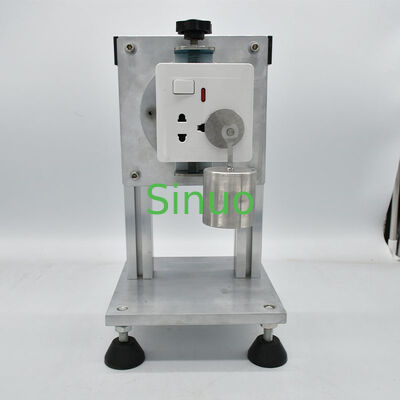
This Lateral Strain Checking Device is a mandatory test fixture for socket safety certification, built to meet IEC 60884-1 Clause 13.14, Figure 13. It verifies whether socket-outlets can resist transverse lateral stress when a plug-in electrical appliance tilts sideways under real usage scenarios.
In daily use, plugged-in chargers and small appliances often hang obliquely and apply lateral force to socket contacts. Excessive deformation, loose contacts or internal damage from this side load will create risks such as overheating, arcing and fire hazards. This test rig reproduces this working condition in a standardized way: insert the standard test plug into the sample socket, apply the specified 5N lateral load, and rotate the assembly within 4° to 90° to evaluate whether the socket suffers unacceptable damage after the test.
This apparatus is applicable for socket-outlets with rated current ≤16A and rated voltage ≤250V, covering most common household wall sockets for European IEC & VDE certification. It is widely adopted by third-party test laboratories and socket manufacturers for type testing, pre-compliance verification and batch quality control.
| Item | Specification |
|---|---|
| Product Name | Device for Checking Lateral Strain |
| Applicable Sample | Socket-outlets ≤16A, ≤250V |
| Standard Reference | IEC 60884-1 Clause 13.14, Figure 13; DIN VDE 0620-1:2021 |
| Standard Test Plug | DIN VDE 0620-1:2021, 1 PC |
| Hanging Weight | 5N, 1 PC |
| Rotation Angle Range | 4° ~ 90°, adjustable |
Mount the test socket sample vertically and insert the DIN VDE standard test plug fully into the socket. Hang the 5N weight on the plug assembly to apply lateral transverse stress. Rotate the mechanism within the 4°–90° range as required by the standard and hold for the specified test duration. After the test, inspect the socket carefully: check for cracking, loose contact parts, permanent deformation or other failures defined by the standard. If no unacceptable damage occurs, the socket passes the lateral strain resistance test.