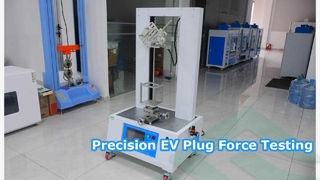
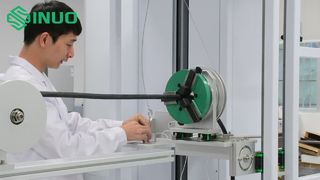
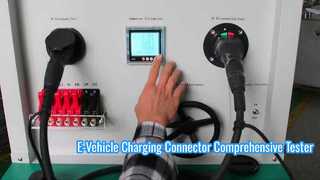
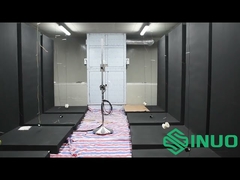
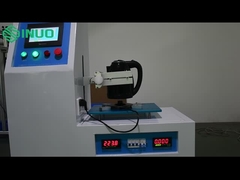
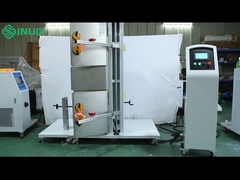
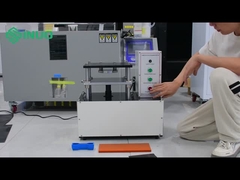
Brief: This video explains the main functions and practical uses of the IEC62196-1 Charging Gun Mechanical Strength Flexing Testing Apparatus in a clear, step-by-step format. You will see a detailed walkthrough of how this equipment performs mechanical load flexing tests on vehicle plugs, socket-outlets, and couplers according to international standards. Watch to learn how the PLC-controlled system with its touch interface and servo motor precisely controls flexing angles, speeds, and cycles for reliable testing.
Related Product Features:
Compliant with IEC62196-1:2022 and IEC60309-1:2012 standards for mechanical load flexing tests on vehicle charging accessories.
PLC control with a 7-inch color human-machine interface for intuitive touch screen operation and parameter setting.
Servo motor drive ensures precise flexing angle control from 0 to 360 degrees, with a default of 90 degrees.
Adjustable flexing rate from 0 to 60 cycles per minute and flexing cycles preset capable up to 999,999.
Mechanical clamping system with adjustable clamping point positions for secure sample holding.
Multiple load weights available including 20N, 25N, 50N, 75N, 100N, 120N, 140N, and 180N.
Test judgment via current conduction signal monitoring for accurate performance evaluation.
Compact equipment dimensions of 850mm × 800mm × 1500mm and weight of approximately 300Kg.
Faqs:
What standards does this flexing testing apparatus comply with?
The apparatus is engineered and manufactured in compliance with IEC62196-1:2022 clause 26.4 table 14 and IEC60309-1:2012 clause 24.4 figure 9 standards for mechanical load flexing tests.
How is the flexing angle controlled and what is the adjustable range?
The flexing angle is precisely controlled by a servo motor and is freely adjustable from 0 to 360 degrees, with a default setting of 90 degrees (45 degrees on either side of vertical).
What are the preset capabilities for flexing cycles and rate?
The system allows presetting of flexing cycles from 0 to 999,999 cycles (default: 20,000 cycles) and flexing rate from 0 to 60 cycles per minute through the touch screen interface.
What power supply is required for operating this testing equipment?
The equipment requires a single phase AC220V±10%, 50/60Hz power supply for operation, with load power provided by an external source.