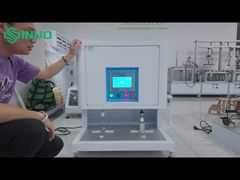
EV Charger Cable Anchorage Test Equipment IEC 61851-1 Pull Force & Torque Testing Machine

Vehicle Testing Equipment
October 09, 2025
Category Connection: Vehicle Testing Equipment
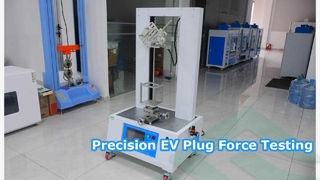
Brief: In this video, we take a focused look at the specifications and what they mean in practice for the EV Charger Cable Anchorage Test Equipment. You will see a detailed demonstration of how this machine performs tensile and torque tests on EV charging connectors according to IEC 61851-1:2017, clause 11.6. We explain the PLC-controlled automated test cycles, the application of precise pulling forces and torques using weights, and how the equipment verifies mechanical strength and compliance with international safety standards.
Related Product Features:
  • Fully compliant with IEC 61851-1:2017, clause 11.6 for testing EV charging station cable connections.
  • Applies controlled pulling force and torque using weight-based tension and torque arm mechanisms.
  • Features PLC automatic control and touch screen operation for easy test cycle management.
  • Tests multiple specifications for pull force (e.g., 160N to 500N) and torque (e.g., 0.6N*m to 16.3N*m).
  • Automatically stops after preset pull cycles (1-999999) or torque application time (up to 99H59M59S).
  • Includes power-off data storage memory function to protect test data during interruptions.
  • Uses a universal clamp fixture to securely hold charging connectors during testing.
  • Operates in environments with 0-40℃ temperature and 30-90% humidity for reliable performance.
FAQs:
  • What standards does this EV Charger Cable Anchorage Test Equipment comply with?
    This equipment is fully compliant with IEC 61851-1:2017, clause 11.6, ensuring it meets international requirements for testing the mechanical strength of EV charging connectors and cable assemblies.
  • How are the pulling force and torque applied during testing?
    Pulling force is applied via a motor-driven mechanism with weights to achieve specifications like 160N, 200N, and up to 500N. Torque is applied using a motor combined with tray weights and a torque arm, covering ranges from 0.6N*m to 16.3N*m.
  • What control features does the testing machine offer?
    The machine uses a PLC automatic control system with a touch screen for operation. It allows preset pull cycles (1-999999) and torque application time (0-99H59M59S), and includes automatic stop and power-off data storage memory.
  • Who is this test equipment designed for?
    It is designed for EVSE manufacturers, test laboratories, and certification bodies to verify the durability and safety of electric vehicle charging connectors and cables, helping ensure compliance with global reliability benchmarks.